Thursday, June 21, 2007
June Flintknapping
Monday, June 4, 2007
Beaver Valley Rock Shelter
Set off a small country road in northern New Castle county, Delaware, is a small and
mysterious cave that is know to have been used by Native Americans and early colonial inhabitants of the area. The cave entrance is obscured by grape and honesuckle vines during the summer months, but can usually be seen after the foliage dies back in the fall.
I visited this cave once when I was a kid with my Grandfather, and it's well known among the locals of this area. My interest in the cave was renewed after reading about it in "The Delaware Indians: A History" by C.A. Weslager. It should have been obvious, but it never occurred to me that the Native Americans used it.
From a survival perspective this cave is amazing. Not only does it sit no more than 30 yards from a beautiful fast flowing stream, but it's only about half a mile from the B
randywine River, and 7 miles from the Delaware River. According to Weslager's book these lands were probably hunting territories of a Lenni Lenape (Delaware) band which lived further up the Brandywine River.

When you approach the entrance it seems to have been formed there deliberatey. The main chamber has several tiers and goes in about 10 feet. The ceiling was high enough for me to stand inside the entrance (6 ft +), but I had to stoop before going any further. The right hal is a low flat area with only about 4ft of clearance, but this whole area would have been perfect to sleep under.
Although it's damp and muddy, not very inviting in its current state, I can see how it would be a fantastic shelter if cleaned up and cared for a bit. The entrance is high enough to afford a fire that would throw light and heat into the cave, and the low sleeping area on the right could be blocked off but
leaning sticks and debris against it. Covering the floor with animal skins or debris would make it even more cozy. To the left there is also a shelf that would be perfect for storing cooking utensils and weapons out of the way.
I've been interested in the pre-history of this area since I was a kid, but after studying survival skills and looking at the landscape from that perspective, I have a much broader appreciation for places like this, and what they must have meant to the native people here.
I visited this cave once when I was a kid with my Grandfather, and it's well known among the locals of this area. My interest in the cave was renewed after reading about it in "The Delaware Indians: A History" by C.A. Weslager. It should have been obvious, but it never occurred to me that the Native Americans used it.
From a survival perspective this cave is amazing. Not only does it sit no more than 30 yards from a beautiful fast flowing stream, but it's only about half a mile from the B
When you approach the entrance it seems to have been formed there deliberatey. The main chamber has several tiers and goes in about 10 feet. The ceiling was high enough for me to stand inside the entrance (6 ft +), but I had to stoop before going any further. The right hal is a low flat area with only about 4ft of clearance, but this whole area would have been perfect to sleep under.
Although it's damp and muddy, not very inviting in its current state, I can see how it would be a fantastic shelter if cleaned up and cared for a bit. The entrance is high enough to afford a fire that would throw light and heat into the cave, and the low sleeping area on the right could be blocked off but
I've been interested in the pre-history of this area since I was a kid, but after studying survival skills and looking at the landscape from that perspective, I have a much broader appreciation for places like this, and what they must have meant to the native people here.
Wednesday, May 30, 2007
Epic Stew
My personal opinion is that she was probably already dead, since turtles can continue moving for quite awhile after death, but Andrew thought othewise. He thinks that since the turtle was moving when he put it in the freezer it is "freezer kill," as opposed to "road kill."
The cleaning instructions we found suggested slicing the skin around the lower shell and cutting the thin bridges connecting it to the upper shell first, so that's what Andrew did.
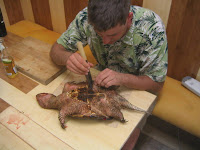
This turtle's shell was 10.25" long and 9.5" wide. According to the NWF field guide Snapping turtles can be from 8-18" long, making this one about medium sized. It also said their peak egg laying season is in June, although they can lay eggs from april until november. The largest recorded number of eggs is 83 (!), though 25-50 is normal. According to this guide they also travel some distance from water to lay eggs, which would explain why this one was crossing a road that wasn't near water. Strong swimmers, they have been known to travel over 2 miles in a few hours when displaced.
The turtle yeilded a surprising amount of meat as well as the 28 eggs. The leg meat was mostly dark, similar to beef or venison, while the neck meat was more like pork or poultry. Pinger located a recipe which recommended that the meat be parboiled to soften it. He cooked in a crockpot overnight, then proceeded to make a fine snapper stew, featuring standard vegetables (carrots, onions, etc.) and sherry as an important ingredient. The stew was incredibly tasty, and disappeared soon after it was made!
After seeing the turtle up close and being nourished from it, I can really see why Native Americans would have held this majestic creature in high regard. It has an ancient feel, like it was formed from the rocks and soil itself...and indeed each spring they emerge from the mud of swamps and streams. With formidable jaws, sharp claws and powerful muscles, as adults they probably know no predator other than humans. This pedatory dominance would give them a special place in lore and mythology.
2 Days at Oregon Ridge
Last month Bill, Pinger and I spent a couple days at Oregon Ridge Nature Center's Primitive Technology weekend. The nature center is located in a beautiful park just west of Baltimore, MD. This was my second time, but Bill's been coming for years.
What makes this event so special for me is that some of the best teachers, artists and experimental archaeologists in the country come together in a small setting and display their work for each other and the general public. Throughout the weekend there were hardcore skills practitioners alongside families that had never even heard of primitive skills. This blending of experiences and perspectives always makes for an interesting time.

There were various skill demonstrations and workshops on both days, and 15-20 vendors selling tools, craft items, or just displaying their art. Below are a few that stood out.
What makes this event so special for me is that some of the best teachers, artists and experimental archaeologists in the country come together in a small setting and display their work for each other and the general public. Throughout the weekend there were hardcore skills practitioners alongside families that had never even heard of primitive skills. This blending of experiences and perspectives always makes for an interesting time.
Bill watches a demonstration by a Danish flintknapper on indirect percussion- using an antler punch struck by a mallet to remove precise flakes. Danish blade cores and axes were made this way.
There were various skill demonstrations and workshops on both days, and 15-20 vendors selling tools, craft items, or just displaying their art. Below are a few that stood out.
Besides the vendors, workshops, and time spent just kicking it and flintknapping, there's also a 24 target archery course through the woods nearby. These courses are designed to loosely simulate hunting in that the terrain, distances and shooting angles vary from target to target. We only got out twice this year but it was a great time.
Thursday, May 24, 2007
Piney Branch Turtle
Today around 8pm there was a medium size snapping turtle at the mouth of the piney branch creek where it flows into the Rock Creek. I was running and stopped on the bridge to check it out. The turtle was pretty active but wasn't going for a curious smallmouth bass that was swimming right in front of its face. There was a also a bottom feeding fish which could've been a small carp, large trout, sucker or something.
When I ran by there a few minutes later there was also a Great Blue Heron fishing. The great bird seemed to get nervous as I paused to watch, and flew gracefully under the bridge out into the main channel of RC.
Earlier at the corner of Newton and 17th I witnessed one of those tough sights that brings up a complex range of emotions. There were two beautiful white eggs, about the size of thimble, laying on the sidewalk, delicate shells shattered and parts of the soon to be born chicks splayed around them. I can only guess what brought them there from the nest 20 ft. above in the tree- whether a Crow, or one of the Jays that also lives on the block. I don't know whether cowbirds live here yet or not.
Since I was there on the April mornings when the birds were scouring the front lawns on Newton for loose twigs, grasses, and the occasional strip of loose plastic, seeing the eggs lying there was even more poignant. I can only imagine what this is like for a parent, but I assume that within a short period of time, these birds will again have eggs in the nest. Resilience is prized in nature.
When I ran by there a few minutes later there was also a Great Blue Heron fishing. The great bird seemed to get nervous as I paused to watch, and flew gracefully under the bridge out into the main channel of RC.
Earlier at the corner of Newton and 17th I witnessed one of those tough sights that brings up a complex range of emotions. There were two beautiful white eggs, about the size of thimble, laying on the sidewalk, delicate shells shattered and parts of the soon to be born chicks splayed around them. I can only guess what brought them there from the nest 20 ft. above in the tree- whether a Crow, or one of the Jays that also lives on the block. I don't know whether cowbirds live here yet or not.
Since I was there on the April mornings when the birds were scouring the front lawns on Newton for loose twigs, grasses, and the occasional strip of loose plastic, seeing the eggs lying there was even more poignant. I can only imagine what this is like for a parent, but I assume that within a short period of time, these birds will again have eggs in the nest. Resilience is prized in nature.
Subscribe to:
Posts (Atom)
